

You've finally acquired your dream bike
, and it is simply stunning.
- A month later, reality kicks in.
- The fuel tank is empty again.
- Another visit to the petrol pump.
- Another payment.
Another moment where you wonder, "Didn't I just fill this last week?"
Now imagine another rider. Same distance. Same roads. Same traffic.
Rather than filling up at a gas station, they simply plug it in when they get home, get up the following day and go again. It seems like such a minor difference. But over months and years, it adds up to one of the highest costs of motorcycle ownership.
So we’re going to answer the question on everyone’s mind in 2026:
Do electric vehicles really save you money, or is it just another fad?
Let’s find out.
Buying a Motorcycle Is a One-Time Expense. Owning It Isn't.
Most people spend weeks comparing bikes before making a purchase.
- They compare colours.
- Top speed.
- Power.
- Features.
- EMIs.
But very few take the time to calculate how much it will cost them in the end after riding that bike for three or four years.
Here lies the truth of the matter: riding a motorbike is like taking up a subscription that one never cancels. Every ride costs something.
For petrol bikes, those costs keep arriving quietly.
Eg, Fuel, Engine oil, Filters, Spark plugs, Clutch wear, Chain maintenance, Periodic servicing.
None of them seem expensive individually. Together, they become the cost of ownership that many riders underestimate.
The Petrol Pump Is Quietly Emptying Wallets
Ask any daily commuter what annoys them the most. It isn't traffic; it isn't a pothole.
It's watching fuel prices climb while their monthly budget stays the same. You don't notice it after one refill. You notice it after fifty.
The frustrating part is that you have absolutely no control over fuel prices. You simply adapt, ride a little less, take shorter routes, skip that weekend ride.
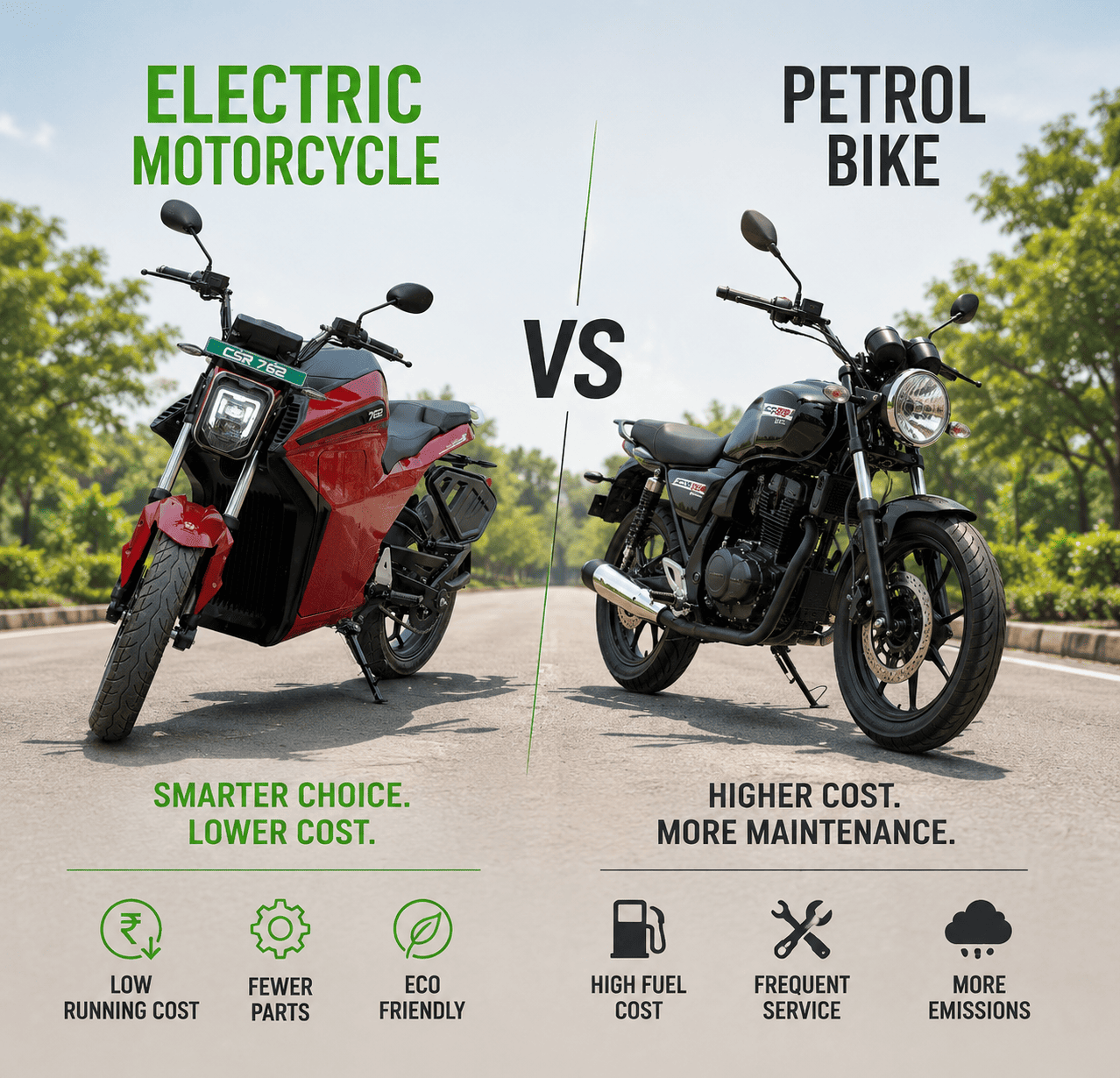
An electric motorcycle changes that relationship. Instead of depending on fuel prices every week, you're charging at home for a fraction of the daily commuting cost.
The feeling is surprisingly different when you stop thinking about the next refill and start thinking about the next ride.
Maintenance Is Where the Difference Becomes Obvious
Here's something many first-time EV buyers don't realise. Electric vehicles don't have an engine. That means they also don't have many of the components that demand regular servicing.
- No engine oil.
- No oil filter.
- No spark plug.
- No clutch assembly.
- No exhaust system.
- No gearbox oil in many designs.
That's a long list of things you simply don't have to think about. Instead of spending weekends waiting outside a service centre, most EV owners spend more time riding than repairing.
It's one of those advantages you only appreciate after living with an electric bike.
"But What About the Battery?"
It’s usually the first question every rider asks. It's a valid one. The battery is the core of an electric bike.
Modern lithium-ion swappable batteries are created to work for years provided they’re operated and charged right. Like any other part, batteries become worn out eventually, but it happens to all engines too.
The point is that modern batteries are much stronger than one could think. Riders will use their motorcycles for years of commuting until their batteries become an issue.
The Riding Experience Costs Nothing But Feels Different
The first time one rides an e-bike and pulls the throttle is an experience of sorts that is truly unique. There are no vibrations from an engine, no need to shift through gears and wait until the engine reaches its full power potential. All of a sudden, riding in the middle of city traffic is much easier, and even waiting at the traffic lights is more relaxed. The biggest difference though is the lack of noise.
Without the continuous rumbling of an engine, one can hear all kinds of things, from birds chirping in the early morning to conversations of people at traffic lights and the wind in your ear while riding. It's not only a new type of motorcycle, but rather a whole new experience on the road.
The Hidden Cost Nobody Talks About
Take into account all the efforts you have put into keeping your traditional motorcycle up and running. In the past year, how often have you stopped to fuel up? How many services have you had to book? How many instances of mechanical failure have interrupted your ride?
It is both costly and time-consuming to own a motorcycle. The electric motorbike, however, removes many of the frustrations associated with motorcycle ownership without even having to think about it. Unlike the conventional motorbike, there is no need to plan for refuelings or maintenance checkups. All you have to do is plug your bike in before sleeping and enjoy your ride.
So, Is Petrol Still the Better Choice?
That will depend upon how you ride your motorbike.
If you are the type of person who rides hundreds of kilometres each day in areas that are far away from the reach of charging stations, then a petrol-powered bike is the ideal option for you.
However, if you ride mostly in the cities and are used for travelling to work, colleges, café stops, and other such places, then an electric motorbike makes more sense.
It's not a matter of whether electric motorbikes can replace petrol bikes.
It's that they already have replaced them for many people.
The Verdict
The real comparison isn't just fuel versus electricity. It's habit versus progress.
A petrol motorbike asks you to keep paying every time you ride.
An electric bike asks you to rethink what ownership can feel like.
- Lower running costs.
- Simpler maintenance.
- A quieter ride.
- Instant torque.
- And fewer visits to the fuel station.
No bike is perfect for everyone.
But if you're looking for a smarter, cleaner, and more economical way to ride in 2026, the numbers and increasingly, the riders are pointing in the same direction.
The best motorcycle isn't just the one that gets you somewhere.
It's the one that lets you enjoy the journey without worrying about what it will cost tomorrow.
Comments (0)
No comments yet — be the first to share your thoughts.